
HIFU may be considered for some people with mild to moderate skin laxity around the jawline, but jowls are not caused by loose skin alone. Facial volume, tissue position, skin quality and underlying structure can also contribute. An assessment helps determine whether focused ultrasound matches the cause of the change rather than treating the appearance alone.
Jowls rarely appear overnight.
You may first notice a slight heaviness beside the chin, a less defined jawline in photographs or a change in the way the lower face meets the neck. Once you notice it, it is easy to start researching tightening treatments and encounter HIFU almost immediately.
But seeing jowls does not automatically mean HIFU is the right treatment.
The important question is what is creating the change in your lower face.
Jowls generally describe soft tissue becoming more noticeable along the lower jawline, particularly beside the chin.
Skin laxity can contribute, but the appearance is often more complex than simply having “loose skin”.
Changes may involve:
That is why two people with apparently similar jowls may receive different treatment recommendations.
One person may have relatively good facial support with mild skin laxity. Another may have deeper structural changes contributing more strongly to the appearance.
HIFU will not necessarily address both situations in the same way.
High-Intensity Focused Ultrasound, usually shortened to HIFU, delivers focused ultrasound energy at selected depths beneath the skin.
The resulting thermal response can support collagen remodelling and may improve tissue firmness over time.
For someone with mild to moderate laxity around the lower face, this can make HIFU worth discussing.
However, the technology does not reposition every structure responsible for jowling, and it cannot be expected to create the same type of change as surgery.
Patients considering HIFU treatment Perth & Fremantle should therefore be assessed according to the degree of laxity and underlying facial anatomy rather than assuming that visible jowls automatically make them a suitable candidate.
This is one of the most important distinctions when considering HIFU.
Someone who has recently noticed a slight softening of the jawline may have very different expectations from someone with more established lower-face laxity.
Focused ultrasound may be considered where the degree of change is compatible with what a non-surgical tightening treatment can reasonably address.
When laxity is more advanced, the potential improvement may be limited.
That does not mean that age determines whether HIFU “works”. A person’s skin quality, facial anatomy and degree of tissue change may be more informative than their date of birth.
This is also why comparing your expected result with someone else’s experience online can be misleading.
Jowls often look different depending on head position, lighting and facial expression.
A front-facing photograph may show fullness beside the chin. From the side, the issue may appear more related to the jawline or neck. Looking slightly downward can exaggerate skin folds that are much less noticeable in a neutral position.
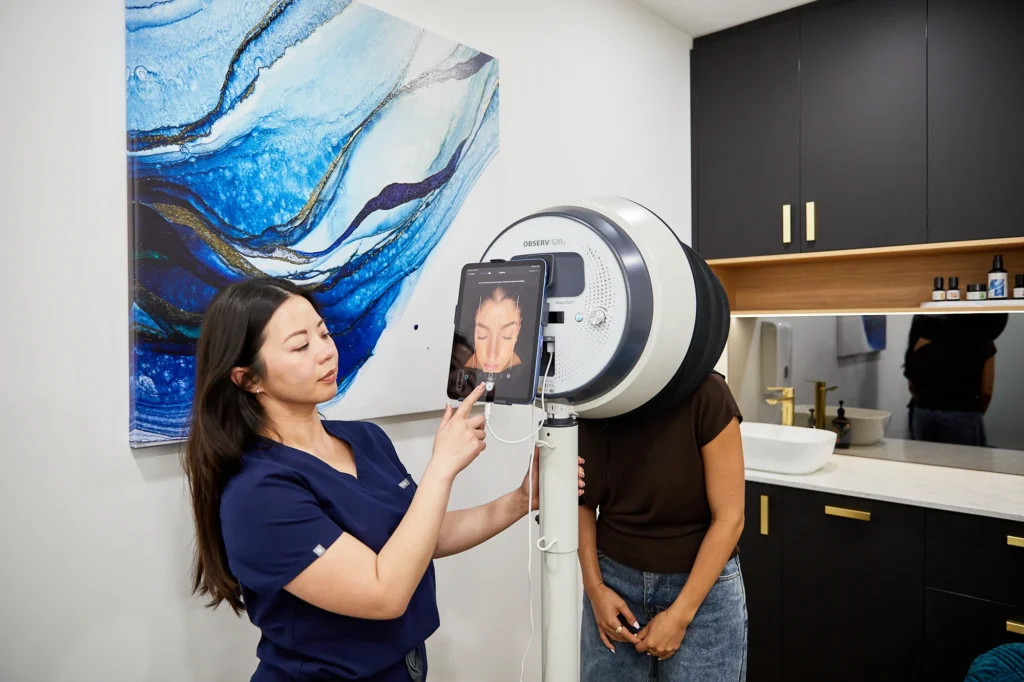
During assessment, the lower face is considered from different angles rather than judging one photograph.
This helps distinguish whether the main issue seems to involve skin firmness, under-chin fullness, facial structure or a combination.
Clinical photography can also be useful when monitoring gradual changes because memory and everyday lighting are not particularly reliable ways to judge subtle differences.
Jawline concerns are not always confined to the area where the jowl is visible.
Chin projection and lower-face proportions can influence the way tissues appear along the jaw.
For example, a shorter or less projected chin can affect the transition from the chin into the jawline. In that situation, simply tightening the skin may not address every feature contributing to the profile.
This does not mean another treatment is automatically required.
It simply illustrates why the visible area is not always the whole story.
A useful consultation considers the lower face as a connected structure rather than isolating one fold of skin.
Jowls and under-chin fullness commonly appear together, but they should not automatically be treated as the same concern.
Fullness beneath the chin may involve:
Someone researching a HIFU double chin treatment Perth & Fremantle may therefore need a slightly different assessment from someone whose concern is confined mainly to early jowling.
Knowing whether the concern involves firmness, fullness or both can help set more realistic expectations.
Some patients hesitate about HIFU because they have read discussions about unwanted facial fat loss.
That concern should not simply be dismissed.
Focused ultrasound can be delivered at different depths, and different tissue layers may be relevant depending on the treatment area and purpose.
For a patient who already has a lean face or wants to preserve facial volume, treatment planning requires particular attention to anatomy, depth and placement.
The aim is not to apply the same pattern of energy to every lower face.
This is another reason practitioner judgement matters when selecting both the area and the treatment settings.
If preserving facial fullness is important to you, raise it directly during your consultation.
There can be a tendency to assume that a stronger treatment must create a better result.
That is not a useful way to think about focused ultrasound.
Energy level, treatment depth and placement need to be appropriate for the tissue being treated. More aggressive settings are not automatically more suitable.
Treatment sensation can also vary significantly.
Some people describe warmth or tingling, while others notice sharper or deeper sensations, particularly around areas close to bone such as the jawline.
Comfort matters, but treatment planning should be driven by anatomy and suitability rather than trying to deliver the maximum possible intensity.
Patient discussions about HIFU often include very different experiences.
Some people feel they noticed a change in firmness. Others describe the result as subtle or say they could barely identify a difference.
Several factors may contribute:
This variability is important.
A non-surgical treatment may produce changes that are gradual and relatively subtle, particularly when compared with surgical procedures or heavily edited before-and-after imagery encountered online.
A consultation should include discussion of what you are likely to notice, what may remain unchanged and whether the expected degree of improvement feels worthwhile to you.
The lower face does not age in isolation.
You might also notice changes in pigmentation, fine lines, skin texture, cheek support or general firmness.
If several features are contributing to an older-looking appearance, focusing exclusively on the jawline may not reflect what bothers you most.
This is where broader anti-ageing treatments Perth & Fremantle can be considered according to the combination of changes present.
That does not mean combining multiple procedures automatically.
It means looking at the face and skin as a whole before deciding which concern, if any, deserves priority.
If you are considering focused ultrasound for jowls, the most useful questions are not necessarily about whether the device is “good”.
Instead, ask:
What seems to be causing my jawline change?
If skin laxity is only a small part of the concern, expectations may need to be adjusted.
How much laxity do I actually have?
Mild and more advanced changes are not equivalent.
Which tissue depths would be treated?
The answer should relate to your anatomy and the area being addressed.
What is unlikely to change?
Knowing the limitations of a treatment can be just as important as knowing its intended effect.
What would make you advise against HIFU for me?
A thoughtful treatment discussion should include circumstances where another approach, monitoring or no treatment may be more appropriate.
There is no universal threshold at which someone should seek advice.
Some people prefer to understand subtle changes early. Others are comfortable waiting until the concern becomes more noticeable.
Either approach can be reasonable.
An assessment is not a commitment to treatment. It can simply help you understand whether the change you are seeing is predominantly related to laxity, facial structure, volume or another factor.
That information may be enough to decide that you want to monitor the area for now.
HIFU is not intended to produce an immediate surgical-style lift.
Changes associated with collagen remodelling generally develop over time, and the degree of visible improvement differs between individuals.
This can make early self-assessment difficult.
Checking the mirror several times a day is unlikely to show a gradual change clearly. Consistent photographs and follow-up assessment can provide a more useful comparison.
Your practitioner can advise when it makes sense to review the area rather than assuming that another treatment should be performed simply because the result is not immediate.
People from Scarborough, Osborne Park and Doubleview who are concerned about a changing jawline can discuss focused ultrasound and other suitable pathways at our Stirling skin clinic.
Patients travelling from Cottesloe, Claremont and Mosman Park can also arrange assessment through our North Fremantle skin clinic.
At our skin clinic Perth & Fremantle, you do not need to decide that HIFU is right for you before arriving. You can attend your consultation with the concern, without having already decided which treatment is right for you. A practitioner can assess what is contributing to the change and explain whether Ultraformer MPT, another approach or simply monitoring the area makes more sense.
A better question is whether the changes contributing to your jowls are of a type and degree that may respond appropriately to HIFU.
For some people, focused ultrasound may be worth considering for mild to moderate laxity around the lower face. For others, skin tightening may address only one part of what they are seeing.
Understanding that distinction before treatment helps keep expectations grounded and makes it easier to decide whether the potential change is meaningful enough for you.
Disclaimer: This article provides general educational information about HIFU, Ultraformer MPT and changes affecting the jawline. It does not replace personalised medical or healthcare advice. Treatment suitability, potential benefits, risks and responses vary between individuals. Always consult an appropriately qualified healthcare professional for assessment and advice relevant to your circumstances.
Our friendly team is ready to help you feel confident and informed.
Cart
Refer a friend
Refer to T&Cs – Clause 91