Skin can start to look older for several reasons beyond wrinkles. Changes in hydration, texture, pigmentation, firmness, facial contours and accumulated sun exposure can all affect the overall appearance of the face. Identifying which features have actually changed provides a more useful starting point than choosing an anti-ageing treatment based on age alone.
Sometimes there is no single wrinkle, spot or line that suddenly catches your attention. You simply look in the mirror or see yourself in a photo and feel that your skin looks different.
Perhaps it seems less fresh, makeup sits differently, your jawline looks softer or your skin appears less even than it used to.
“Looking older” describes what you have noticed, but it does not explain what has changed. Several processes can create a similar overall appearance, so identifying the individual concern can be much more useful than immediately searching for a treatment.
Age is not a skin diagnosis.
Two people of the same age may have completely different concerns depending on genetics, sun exposure, skin type, lifestyle, facial structure and previous skin care.
Instead of asking, “What should I be doing at my age?”, look more closely at the change itself.
You might notice:
These observations give a practitioner much more useful information than your age alone.
Sometimes the change is largely about skin quality.
Hydration, smoothness and the condition of the skin barrier affect how light reflects from the face. When skin becomes rougher or dehydrated, fine lines may appear more obvious and the complexion can look less even.
This can also happen when a skincare routine becomes too complicated. Introducing several active ingredients, exfoliating too frequently or repeatedly changing products may leave some people with irritated or dry skin. In that situation, adding another intensive procedure may not be the most appropriate first step.
COCO offers skin treatments tailored to different concerns where the condition of the skin can be considered before deciding whether professional treatment is appropriate.
Pigmentation often develops gradually.
Years of sun exposure may become visible through freckles, uneven patches or areas of darker colour. Because these changes accumulate over time, the overall complexion can eventually look quite different even when there has been no dramatic change in facial structure.
Pigmentation also needs to be separated from texture and laxity.
A treatment designed to support skin firmness does not necessarily address uneven colour. Likewise, treating pigmentation will not correct a structural change in the jawline.
If colour is one of the main things you have noticed, an assessment for pigmentation concerns and treatment options can help clarify what type of change is present.
Not every line develops in the same way.
Some are most noticeable when you smile, frown or raise your eyebrows. Others remain visible when your face is relaxed. Very fine surface lines can also become more obvious when skin is dry or its texture has changed.
This is why simply counting wrinkles does not tell you very much.
It is more useful to notice:
Those details help separate surface skin changes from movement-related or structural concerns.
The lower face is often where people first notice that something has shifted.
Your jawline may seem less defined in photographs. The transition between the chin and neck may look softer. Early jowling can become more visible from certain angles.
Skin firmness can certainly play a role, but it is not the only possibility.
Facial volume, tissue position, underlying structure and individual anatomy can also influence the shape of the lower face.
This distinction matters because treating the wrong tissue may not address the feature that is actually bothering you.
Patients exploring anti-ageing treatments Perth and Fremantle may therefore benefit from looking at skin quality, firmness and facial contours separately rather than treating them as one general ageing concern.
“Tired” is one of the most common ways people describe a facial change, but it can mean several different things.
Darkness beneath the eyes can affect how rested the face appears. Dehydration may make fine lines more noticeable. Pigmentation can create uneven colour, while changes through the cheeks or lower face can alter the way shadows fall across the face.
Before deciding that you need a particular treatment, try to narrow down what “tired” means for you.
Is the concern mainly around the eyes? Does it remain throughout the day? Is the skin itself dull or dry? Has the contour of the face changed? Does the concern appear more strongly in certain lighting?
You do not need to know the technical explanation. Being able to describe what you see is enough to start a useful conversation.
Skin does not remain static.
Hormonal changes, environmental exposure, medications, lifestyle, sun exposure and changes in barrier function can all influence how it behaves over time.
A routine that worked well several years ago may therefore need adjusting.
That does not automatically mean adding more products.
If your skin has become sensitive, dry or reactive, increasing the number of active ingredients may make the situation harder to understand. Irritation itself can exaggerate roughness and fine lines.
A skincare review can look at what you already use, what each product is intended to do and how your skin responds before deciding whether anything needs to change.
If you are struggling to work out why your skin looks different, it can help to stop thinking about treatments for a moment.
Instead, sort what you are noticing into a few simple categories.
Colour
This includes pigmentation, sun spots, persistent redness and areas of uneven tone.
Surface
Think about dryness, roughness, enlarged-looking pores or a change in how smooth the skin feels.
Lines
Notice whether lines appear mainly with movement or remain when your face is relaxed.
Firmness
Look for areas where the skin feels softer, less resilient or mildly lax.
Contour
Consider whether the cheeks, jawline, chin or lower face have changed in shape.
You may identify several categories at once. That does not mean you need a treatment for each one.
It simply makes the overall concern easier to understand.
It is easy to research backwards.
You notice a change in your face, discover a treatment online and then start trying to determine whether you are a candidate for that procedure.
But different technologies are designed for different concerns.
Laser and light treatments may be considered for certain pigmentation, redness or skin-quality concerns. Skin needling may be relevant to selected textural changes. Energy-based treatments have different roles again when skin firmness is part of the issue.
None is automatically the “best anti-aging treatment”.
The more useful sequence is to understand the visible change first and compare treatment options afterwards.
This is particularly important when several factors overlap. For example, a softer lower face and uneven pigmentation may both contribute to an older-looking appearance, but they are not the same problem and would not necessarily be approached in the same way.
It is completely reasonable to know that something has changed without knowing what to call it.
You might tell your practitioner:
“My jawline looks different in photos.”
“My skin doesn’t feel as smooth anymore.”
“I seem to have more uneven colour.”
“My makeup is settling differently.”
“I look tired even when I don’t feel tired.”
“I can’t identify one thing, but my face looks different.”
Those descriptions are useful.
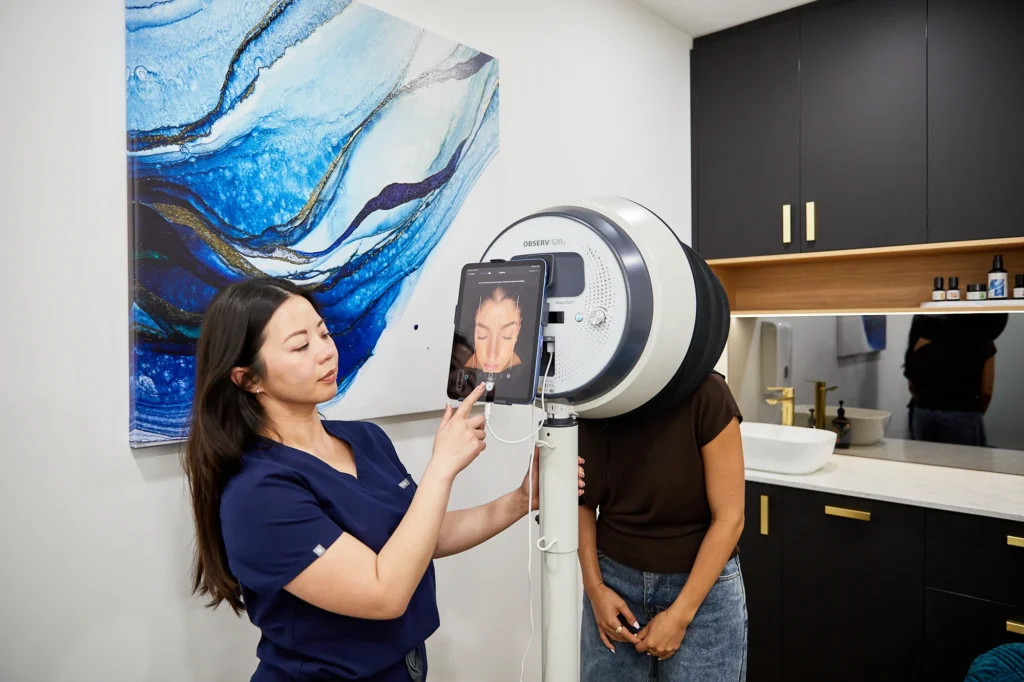
During an appointment, a practitioner can look more closely at skin texture, pigmentation, facial movement, firmness and other features that may contribute.
At our skin clinics Perth & Fremantle, the conversation can begin with what you have noticed rather than expecting you to arrive knowing which treatment you want.
A consultation does not have to lead directly to a procedure.
Your main concern may be something that can initially be approached through skincare or sun protection. You may discover that the change is subtle enough that you would rather monitor it. A treatment you researched may also turn out not to match the feature you want to address.
That information still has value.
For many people, the goal is not to remove every visible sign of ageing. It is to understand their skin, look after it appropriately and make informed choices about the changes that matter to them.
Sometimes that means treatment. Sometimes it means a simpler plan.
When several changes appear together, it can be tempting to create a long list of concerns to address.
A more manageable approach is to identify the one or two features that have the greatest influence on how you feel about your skin.
If uneven colour is what catches your eye first, start there.
If the main issue is dryness and texture, that may deserve attention before other concerns.
If reduced firmness or facial contours are more noticeable, those can be assessed separately.
Patients considering anti-aging treatments Perth and Fremantle do not necessarily need a multi-treatment plan. Priorities can be discussed first, with options considered according to what is most relevant.
Instead of asking:
“What is the best anti-aging treatment for my age?”
try:
“What exactly has changed, and which part of that change matters to me?”
That question shifts the focus away from age and towards the skin itself.
Once you know whether you are mainly dealing with colour, texture, lines, firmness, contour or a combination, it becomes easier to understand which options are relevant and which can be ruled out.
You may also decide that you are comfortable with some of the changes you see.
Positive ageing does not require treating every line, spot or shift in facial shape.
Patients travelling from Doubleview, Scarborough and Osborne Park can visit our Stirling skin clinic when they want guidance around changing skin texture, pigmentation, firmness or other age-related concerns.
Those living around Cottesloe, Mosman Park and Claremont can access consultations through our North Fremantle skin clinic.
Wherever you are starting from, you do not need to arrive with a treatment name in mind. Being able to say, “My skin looks different and I want to understand why” is already a useful place to begin.
Disclaimer: This article provides general educational information about age-related skin changes and cosmetic skin care. It does not replace personalised medical or healthcare advice. Skin characteristics, treatment suitability, potential risks and treatment responses vary between individuals. Always consult an appropriately qualified healthcare professional for advice based on your circumstances.
Our friendly team is ready to help you feel confident and informed.
Cart
Refer a friend
Refer to T&Cs – Clause 91